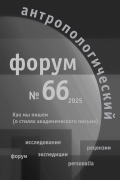
How We Write: On Styles of Academic Prose

Authors

  • Andrey Adelfinskiy Bauman Moscow State Technical University Автор
  • Maria Akhmetova The Russian Presidential Academy of National Economy and Public Administration (RANEPA) Автор
  • Albert Baiburin Peter the Great Museum of Anthropology and Ethnography (Kunstkamera), RAS; European University at St Petersburg Автор
  • Anastasiya Belyaeva Pirogov Russian National Research Medical University Автор
  • Yuri Berezkin Peter the Great Museum of Anthropology and Ethnography (Kunstkamera), RAS; European University at St Petersburg Автор
  • Olga Boitsova Peter the Great Museum of Anthropology and Ethnography (Kunstkamera), RAS Автор
  • Evgeniy Vdovchenkov Institute of Oriental Studies, RAS Автор
  • Aleksandra Zakharova Sociological Institute of FCTAS RAS Автор
  • Stepan Kalinin Perm National Research Polytechnic University Автор
  • Natalia Kovalyova The University of North Texas Автор
  • Georgij Levinton European University at St Petersburg Автор
  • Julia Safronova European University at St Petersburg Автор
  • Sergey Sokolovskiy Institute of Ethnology and Anthropology, RAS Автор
  • Polina Yarovaya HSE University Автор

DOI:

https://doi.org/10.31250/1815-8870-2025-21-66-11-96

Keywords:

academic writing, scholarly style

Abstract

Every era has its own “mainstream scholarly style” — the generally accepted way of writing academic texts in а given era and place. To today’s tastes, many academic texts written a century and more ago seem verbose and impersonal, weighed down with dispensable reflections and ruminations. Soviet academic style was radically different from English-language publications of the time, but these days many Russian academic texts read like translations from English. The Editorial Board of Forum for Anthropology and Culture invited its readers to reflect on what is happening to modern Russian academic prose.

Downloads

Published

2025-09-25

How to Cite

How We Write: On Styles of Academic Prose. (2025). Antropologicheskij Forum Forum for Anthropology and Culture, 66, 11–96. https://doi.org/10.31250/1815-8870-2025-21-66-11-96